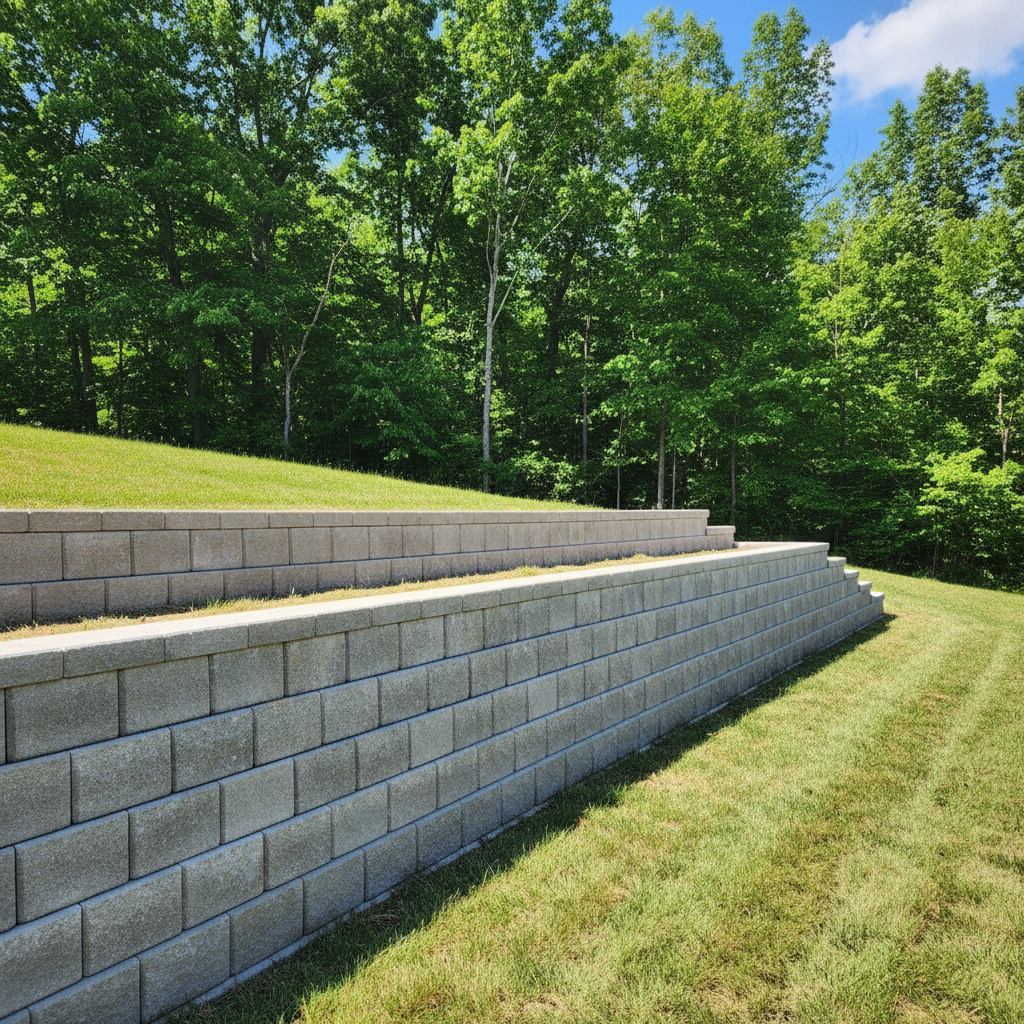
You need a Concrete Retaining Wall. Your backyard in Maryville might be sloping too much towards your house. You might also be trying to get more usable space on a hilly lot. You are probably asking about the cost for this Concrete Retaining Wall project. This is a fair question. It is also a question Allied Concrete gets all the time. As a local contractor in Maryville, we have seen many projects. We can tell you that there is no single answer for the cost. We can definitely give you some realistic numbers for your Concrete Retaining Wall project in Maryville.
What Really Drives the Price Tag for a Concrete Retaining Wall?
A few big things will make the cost of your Concrete Retaining Wall go up or down. It is not just about how long or how tall the wall is. These are important factors as well. Think of it like building anything else. The more complex the project is, the more expensive it will be. Here is what our team typically looks at for Concrete Retaining Walls in Maryville:
- Wall Height and Length: This is the most obvious factor for a Concrete Retaining Wall. A small, two-foot-tall garden wall is very different from a six-foot structural wall. A six-foot structural wall holds back a lot of earth. Taller walls need deeper footings as well as more rebar. These taller walls often need professional engineering to make sure they do not fail. For Concrete Retaining Walls up to 4 feet tall, you might see costs between $20 to $50 per linear foot. Taller Concrete Retaining Walls, over 4 feet, can jump to $40 to $100 or more per linear foot.
- Type of Concrete: You have options for your Concrete Retaining Wall. Poured Concrete Walls are very strong. They handle a lot of earth pressure. These generally run $30 to $60 per linear foot for walls up to 4 feet tall. Concrete Block (CMU) Walls are a bit more economical. These usually cost $20 to $45 per linear foot. In addition, there are segmental retaining wall blocks. These are interlocking landscape blocks. They are typically $15 to $35 per linear foot for walls up to 3 feet tall.
- Site Accessibility: We need to know if we can get our heavy equipment right up to where the Concrete Retaining Wall needs to go. If we have to hand-dig or haul materials a long way, that will add to the labor cost. This happens because your backyard is tight. This is especially true on some of those steeper, wooded lots we see around Maryville. Getting a Bobcat into these areas can be a real challenge.
- Soil Conditions & Drainage: This is a big factor for a Concrete Retaining Wall. Homeowners often overlook this. If your soil is unstable or has a lot of clay, we might need extra excavation. We might also need specialized backfill. More extensive drainage systems could also be needed. Proper drainage behind the wall is important. It prevents water pressure from pushing the wall over. You do not want your Concrete Retaining Wall to turn into a dam.
- Permits and Engineering: Concrete Retaining Walls over 3 or 4 feet tall almost always need engineering plans as well as permits. This is not just bureaucracy. It is about safety. Those engineering fees can add $2,000 to $5,000 to your project. They are non-negotiable for structural Concrete Retaining Walls.
- Finishes and Aesthetics: Do you want a plain concrete finish for your Concrete Retaining Wall? You might also be looking for something decorative. This could be stamped concrete as well as a veneer or a special color. Those enhancements will increase the material costs as well as the labor costs.
Typical Cost Ranges for a Concrete Retaining Wall in Maryville
Let us talk about real numbers for a Concrete Retaining Wall in Maryville. These are averages. Your specific project could be higher or lower. This depends on those factors we just mentioned.
For most residential Concrete Retaining Walls, you are probably looking at a total project cost. This cost will be somewhere in the range of $3,000 to $10,000. Some smaller, simpler garden walls might cost around $2,000 to $6,000. If you are talking about a large, complex structural Concrete Retaining Wall over 4 feet tall, it needs engineering. You could easily be looking at $15,000 to $25,000 or even more.
Here is a general breakdown per linear foot for concrete options:
- Poured Concrete: Expect $30-$60 per linear foot for Concrete Retaining Walls up to 4 feet. For taller, more complex poured walls, it could be $60-$270 per linear foot.
- Concrete Block (CMU): This usually costs $20-$45 per linear foot.
- Segmental Block: This is $15-$35 per linear foot for smaller Concrete Retaining Walls (under 3 feet).
A typical 50-foot residential Concrete Retaining Wall that is 3 feet tall could cost you $1,000 to $2,500 for the wall itself. This does not include all the other costs. These other costs include excavation, drainage, and potentially engineering.
What Should a Good Concrete Retaining Wall Quote Include?
When you get a quote from Allied Concrete, it should not just be a single number. This is true for any reputable contractor. You need to see a breakdown. Here is what you should expect from your Concrete Retaining Wall quote:
- Detailed Scope of Work: This describes exactly what is being built. It includes the type of concrete as well as the dimensions (height, length, width). Any special features will also be included.
- Materials: A clear list of materials will be provided. This includes concrete, rebar, drainage pipe, and gravel. Any finishing materials will also be listed.
- Labor Costs: This covers the crew's time. This includes excavation, forming, pouring, finishing, and cleanup. Labor can be 40% to 60% of the total project cost for your Concrete Retaining Wall.
- Site Preparation: This includes excavation as well as grading. It also includes the removal of any existing structures or debris. If your yard needs significant grading, that will be listed.
- Drainage System: Details on the drainage setup will be included. This means perforated pipes as well as gravel backfill and weep holes. This is important for the wall's longevity.
- Permits and Engineering: These costs should be itemized if they are required.
- Hauling and Disposal: This covers getting rid of excavated dirt as well as construction debris.
- Warranty Information: The quote will tell you what kind of guarantee you get on the work.
How to Avoid Overpaying for Your Concrete Retaining Wall
Nobody wants to get ripped off when building a Concrete Retaining Wall. Here is how you can be a smart homeowner for your Concrete Retaining Wall project:
- Get Multiple Bids: Do not just go with the first contractor you talk to. Get at least three detailed quotes. This helps you compare bids. It also helps you understand the market rate for a Concrete Retaining Wall in Maryville.
- Ask for References and Check Reviews: A good contractor will have happy customers. Call their references. Look at online reviews as well.
- Understand the Details: Do not be afraid to ask questions about anything you do not understand in the quote. You can ask why one quote is higher than another. You can also ask if it is different materials. It could also be a better drainage system. Sometimes it is just more overhead.
- Do Not Skimp on Engineering (if needed): We know it is an extra cost. An engineer's design makes sure your Concrete Retaining Wall is safe. It will also last. This is a small investment. It prevents a much larger, more dangerous problem later on.
- Consider the Long-Term Value: Spending a little more upfront on quality materials can save you money. Proper installation also helps. This means you will not have to deal with repairs or replacement later. A cheap wall that fails is never a good deal.
- Be Clear About Your Expectations: Make sure you and your contractor are on the same page. This includes the final look as well as the function and the timeline. Misunderstandings lead to change orders. Change orders lead to higher costs.
Building a Concrete Retaining Wall is a big investment. It can add a lot of value to your property. It also adds a lot of functionality. This is especially true with the sloped terrain we often deal with here in Blount County. Do your homework. Ask the right questions. You will end up with a solid Concrete Retaining Wall that serves you well for many years to come.